
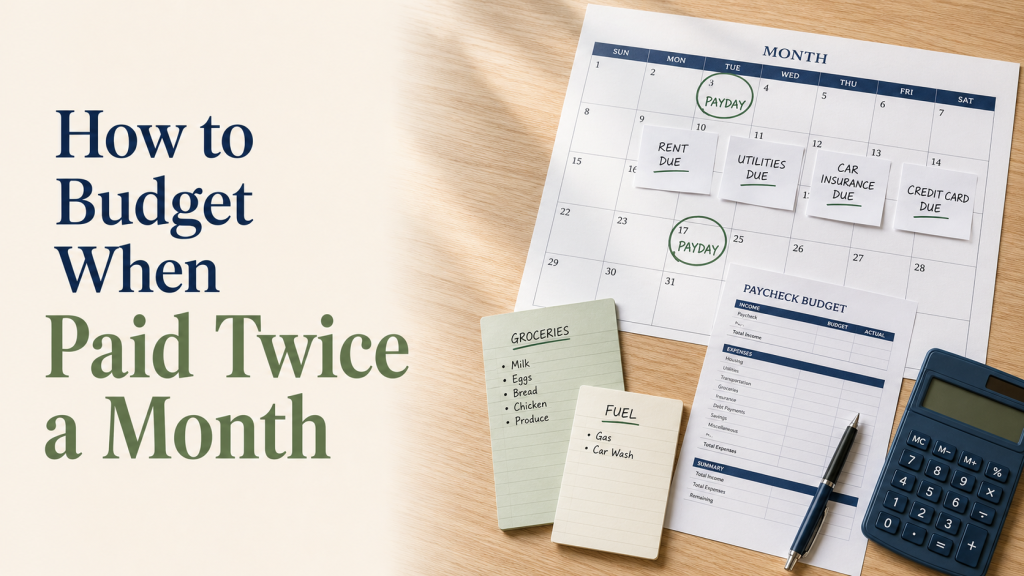
How to Budget When Paid Twice a Month
Learning how to budget when paid twice a month can make it much easier to organize bills, groceries, savings, and everyday spending between two predictable paydays.
If you receive two paychecks each month, your budgeting system should answer one simple question:
What does each paycheck need to cover before the next one arrives?
Instead of creating one large monthly spending plan and hoping the money lasts, divide the month into two paycheck periods.
Use the Paycheck Budget Planner Printable to assign every bill and spending category to the paycheck that needs to cover it.
What Does Being Paid Twice a Month Mean?
Being paid twice a month is usually called semi-monthly pay.
You normally receive:
24 paychecks per year
Common payday schedules include:
- 1st and 15th
- 15th and last day of the month
- 5th and 20th
- Two fixed company payroll dates
The important feature is that you receive two paychecks during each calendar month.
This is different from being paid biweekly.
Paid Twice a Month vs. Biweekly Pay
These schedules are easy to confuse.
Twice a month
You receive:
24 paychecks per year
The dates are often fixed.
For example:
- September 1
- September 15
- October 1
- October 15
Biweekly
You receive a paycheck:
every 14 days
That normally creates:
26 paychecks per year
Some months contain two paychecks and some contain three.
If you are paid every two weeks instead of exactly twice per month, use the Biweekly Budget Planner Printable and read How to Split a Biweekly Paycheck.
Why Budgeting Twice-Monthly Pay Can Be Easier
A semi-monthly schedule gives you predictable income dates.
You know that every month contains:
- Paycheck 1
- Paycheck 2
That makes it easier to assign recurring expenses.
For example:
Paycheck 1
- Rent
- Electricity
- Groceries
- Fuel
- Phone
Paycheck 2
- Insurance
- Internet
- Groceries
- Fuel
- Debt
- Savings
The goal is to balance the two paycheck periods rather than allowing one paycheck to carry almost every expense.
A Simple Twice-a-Month Budget Example
Suppose your monthly take-home income is:
$3,600
You receive:
$1,800 twice per month
Monthly expenses:
- Rent: $1,000
- Utilities: $250
- Groceries: $500
- Transportation: $240
- Insurance: $150
- Phone and internet: $140
- Debt payments: $250
- Savings: $200
- Household: $100
- Personal spending: $100
- Buffer: $70
Total:
$3,000
Money remaining:
$600
You could divide the expenses between two paycheck periods rather than trying to manage all $3,600 at once.
How to Budget When Paid Twice a Month
Step 1: Write Down Both Paydays
Start with the exact dates.
For example:
Paycheck 1 — September 1
Paycheck 2 — September 15
Then identify when the next month begins.
This gives you two spending periods.
Period 1
September 1–14
Period 2
September 15–30
Every expense should belong to one of these periods or be reserved in advance.
Step 2: Record the Amount of Each Paycheck
Suppose:
Paycheck 1
$1,800
Paycheck 2
$1,800
Total:
$3,600
If the two paychecks are not identical, use the actual expected amounts.
Do not build the plan using gross salary.
Budget with the amount that actually reaches your account.
Step 3: List Every Bill and Due Date
Create a complete bill list.
Example:
- Rent — 3rd — $1,000
- Electricity — 7th — $150
- Phone — 11th — $80
- Insurance — 18th — $150
- Internet — 22nd — $60
- Car payment — 27th — $280
Use the Bill Tracker Printable PDF to keep all bill names, amounts, due dates, and payment status together.
Step 4: Assign Bills to the Paycheck Before Their Due Date
Start with a simple rule:
The paycheck immediately before the due date funds the bill.
Example:
Paycheck 1
- Rent: $1,000
- Electricity: $150
- Phone: $80
Total bills:
$1,230
Paycheck 2
- Insurance: $150
- Internet: $60
- Car payment: $280
Total bills:
$490
You can already see that the first paycheck is much more heavily loaded.
That is where paycheck balancing becomes important.
Step 5: Add Groceries to Both Paychecks
Suppose monthly groceries are:
$500
A simple starting split is:
Paycheck 1
$250
Paycheck 2
$250
You can adjust the numbers if one period contains more days or a larger grocery trip.
Do not fund all monthly groceries from one paycheck.
Step 6: Add Transportation to Both Paychecks
Suppose monthly transportation is:
$240
Split it:
Paycheck 1
$120
Paycheck 2
$120
If work schedules differ between the two periods, adjust the amounts.
The goal is to have enough transportation money until the next payday.
Step 7: Add Other Everyday Expenses
Include:
- Household supplies
- Medication
- School expenses
- Personal spending
- Pet expenses
- Takeout
- Entertainment
Suppose each paycheck receives:
- Household: $50
- Personal spending: $50
That adds:
$100
to each paycheck period.
Step 8: Calculate the First Paycheck
Suppose Paycheck 1 is:
$1,800
Expenses:
- Rent: $1,000
- Electricity: $150
- Phone: $80
- Groceries: $250
- Transportation: $120
- Household: $50
- Personal: $50
Total:
$1,700
Money remaining:
$100
That leaves very little room for savings or unexpected costs.
Now compare this with Paycheck 2.
Step 9: Calculate the Second Paycheck
Paycheck 2:
$1,800
Expenses:
- Insurance: $150
- Internet: $60
- Car payment: $280
- Groceries: $250
- Transportation: $120
- Household: $50
- Personal: $50
Total:
$960
Money remaining:
$840
The problem is obvious.
Paycheck 1 is overloaded while Paycheck 2 has much more room.
Step 10: Balance the Paychecks
Instead of allowing the first paycheck to struggle every month, move part of future expenses into Paycheck 2.
For example, use Paycheck 2 to reserve:
$400 toward next month’s rent
Now:
Paycheck 2
Original expenses:
$960
Next month rent reserve:
$400
New total:
$1,360
Remaining:
$440
Then next month’s first paycheck needs only:
$600
for rent instead of $1,000.
This makes both periods much easier.
For a detailed method, read How to Plan Bills Around Your Paychecks.
Step 11: Split Large Bills Between the Two Paychecks
Another option is to divide large bills.
Suppose rent is:
$1,000
Reserve:
Paycheck 1
$500
Paycheck 2
$500
The money may technically come from the previous month’s second paycheck and the current month’s first paycheck.
The important point is that one paycheck does not carry the entire $1,000 alone.
Step 12: Add Savings to Both Paychecks
Suppose your monthly savings goal is:
$200
Instead of waiting until the end of the month:
Paycheck 1
Save:
$100
Paycheck 2
Save:
$100
This makes saving part of the paycheck plan rather than something you do only if money happens to remain.
Step 13: Add a Small Buffer
Suppose each paycheck receives:
$40
as a buffer.
Monthly buffer:
$80
That money can absorb:
- Higher groceries
- Extra fuel
- A slightly higher utility bill
- Small household expenses
Read How to Build a Budget Buffer if small unexpected costs regularly throw off your monthly plan.
Step 14: Use Weekly Spending Limits Inside Each Paycheck Period
A twice-monthly paycheck may need to last approximately two weeks.
Suppose you have:
$500
available for flexible spending.
Instead of treating all $500 as immediately available, divide it:
Week 1
$250
Week 2
$250
This protects money needed later in the paycheck period.
Use the Weekly Budget Planner Printable and read How to Set a Weekly Spending Limit if spending tends to happen too quickly after payday.
A Complete Twice-Monthly Paycheck Example
Monthly income:
$3,600
Paycheck 1 — $1,800
- Rent reserve: $600
- Electricity: $150
- Phone: $80
- Groceries: $250
- Transportation: $120
- Household: $50
- Savings: $100
- Personal spending: $50
- Buffer: $40
Total:
$1,440
Remaining:
$360
Paycheck 2 — $1,800
- Future rent reserve: $400
- Insurance: $150
- Internet: $60
- Car payment: $280
- Groceries: $250
- Transportation: $120
- Household: $50
- Savings: $100
- Personal spending: $50
- Buffer: $40
Total:
$1,500
Remaining:
$300
Now both paycheck periods have breathing room.
What if Most Bills Are Due After the First Paycheck?
This is common.
Rent, utilities, insurance, and loan payments may cluster during the first half of the month.
Do not wait until Paycheck 1 arrives to fund everything.
Use Paycheck 2 from the previous month to reserve part of those bills.
For example:
Next month early bills:
$1,500
Reserve from this month’s second paycheck:
$400
Next month’s first paycheck needs:
$1,100
instead of $1,500.
What if a Bill Is Due Before Payday?
Suppose:
Insurance due — September 13
Paycheck:
September 15
You cannot use the September 15 paycheck.
The money needs to come from the previous paycheck.
Read How to Budget for Bills Due Before Payday for a detailed bill-reserve system.
Use a Monthly Bill Calendar
A calendar makes the two-paycheck system easier to see.
Mark:
- Paycheck 1
- Paycheck 2
- Every bill due date
- Automatic withdrawals
- Debt payments
- Irregular expenses
Then visually assign expenses to the income that needs to cover them.
Read How to Create a Monthly Bill Calendar for the full setup.
What if Your Two Paychecks Are Different Amounts?
Suppose:
Paycheck 1
$1,600
Paycheck 2
$1,900
Do not automatically divide every category 50/50.
Assign more expenses to the larger paycheck.
For example:
Paycheck 1
Required expenses:
$1,400
Remaining:
$200
Paycheck 2
Required expenses:
$1,500
Remaining:
$400
This can be more realistic than forcing identical paycheck budgets.
What if You Are Living Paycheck to Paycheck?
Start by creating a small gap between income and spending.
Possible first goals:
- $25 left before payday
- $50 paycheck buffer
- One bill funded early
- One week of groceries funded early
- Part of next month’s rent reserved
Once the system becomes stable, work toward getting more expenses ahead.
Read How to Get One Month Ahead on Bills for a gradual approach.
What if Money Is Tight?
Prioritize:
- Housing
- Essential utilities
- Groceries
- Transportation required for work
- Healthcare
- Insurance
- Minimum required debt payments
- Other essential expenses
- Savings when possible
- Optional spending
Use the Low Income Budget Planner if both paychecks together still struggle to cover essential expenses.
Track Actual Spending Between Paydays
Do not assume the original plan is accurate.
Track:
- Groceries
- Fuel
- Household spending
- Personal purchases
- Takeout
- Other everyday expenses
Use the Expense Tracker Printable PDF to compare the planned paycheck budget with what actually happened.
Adjust the Next Paycheck
Suppose:
Paycheck 1 grocery budget:
$250
Actual:
$285
Difference:
$35
Do not ignore it.
Decide whether to:
- Reduce another category
- Use part of the buffer
- Adjust Paycheck 2
- Increase the grocery budget permanently if this happens regularly
Paycheck budgeting should respond to real spending.
Common Twice-a-Month Budgeting Mistakes
Treating Both Paychecks as Separate Money
They are two parts of one monthly budget.
Spending Too Much After Payday
Use weekly limits inside each paycheck period.
Funding Large Bills From One Paycheck
Reserve part of them earlier.
Forgetting Next Month
The second paycheck may need to fund bills due early next month.
Ignoring Bill Due Dates
Match every bill to a paycheck.
Saving Only at the End of the Month
Assign savings when the paycheck arrives.
Having No Buffer
Leave some breathing room.
Confusing Twice-Monthly and Biweekly Pay
The schedules create different numbers of annual paychecks.
Download the Free Paycheck Budget Planner
The printable Paycheck Budget Planner helps you:
- Record both monthly paychecks
- List bills due before the next payday
- Plan groceries and transportation
- Reserve money for future bills
- Add savings and debt payments
- Build a paycheck buffer
- Calculate money remaining
- Balance both paycheck periods
Start with your next two paydays and assign every upcoming bill and essential expense to one of them.
Explore more free budget templates and printable PDF trackers for weekly budgeting, bills, expenses, debt, emergency funds, and sinking funds.
Frequently Asked Questions
How do I budget if I get paid twice a month?
Divide the month into two paycheck periods and assign every bill, essential expense, savings contribution, and spending category to one of the two paychecks.
Is twice a month the same as biweekly?
No. Twice-monthly pay normally produces 24 paychecks per year, while biweekly pay normally produces 26.
Should I split every bill in half?
Not necessarily. Split large bills when it makes cash flow easier, but smaller bills can simply be assigned to the paycheck before their due date.
What if one paycheck has most of my bills?
Use the other paycheck to reserve part of future large bills, especially expenses due early in the following month.
Should I budget groceries by paycheck?
Yes. Dividing groceries and other everyday expenses between both paychecks helps prevent overspending early in the month.