
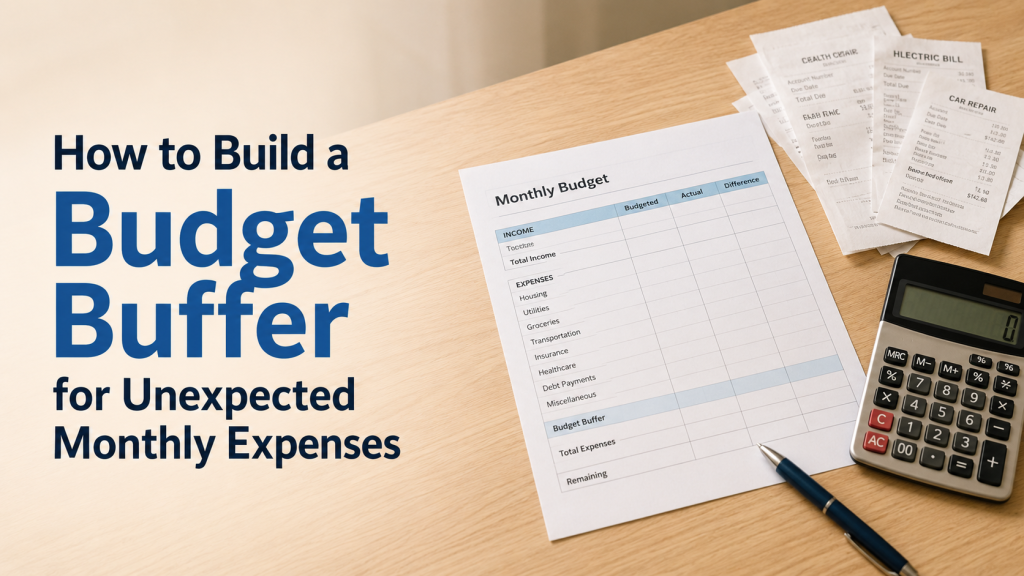
How to Build a Budget Buffer for Unexpected Monthly Expenses
Learning how to build a budget buffer can make your monthly plan much more realistic.
Even a carefully planned budget rarely works exactly as expected.
Groceries may cost $18 more than planned. You may need additional fuel. A utility bill may be slightly higher. Your child may suddenly need something for school. A household item may need replacing.
None of these expenses necessarily qualify as financial emergencies.
But without extra room in your budget, even a small unexpected cost can force you to use a credit card, move money from another bill, or take money from savings.
A budget buffer solves that problem.
Use the Simple Budget Planner to create a small monthly cushion between your planned expenses and your total income.
What Is a Budget Buffer?
A budget buffer is a small amount of money intentionally left unassigned for normal unexpected expenses.
For example:
Monthly income:
$3,200
Planned expenses:
$3,050
Budget buffer:
$150
Instead of assigning every dollar of income before the month begins, the $150 provides room for normal variations.
It might cover:
- A higher grocery bill
- Extra fuel
- A utility increase
- School expenses
- Household supplies
- A small pharmacy purchase
- Pet supplies
- A minor repair
- An unexpected fee
The buffer protects the rest of your budget.
Budget Buffer vs. Emergency Fund
These two categories have different jobs.
Budget buffer
Used for smaller monthly differences that are inconvenient but manageable.
Examples:
- Groceries cost $25 more
- Electricity is $18 above the estimate
- You need $30 of extra fuel
- A school activity costs $20
Emergency fund
Used for larger, urgent, genuinely unexpected expenses.
Examples:
- Major car repair
- Emergency medical expense
- Job loss
- Broken essential appliance
- Emergency home repair
Use the Emergency Fund Tracker Printable to keep true emergency savings separate from your normal monthly buffer.
Why Budgets Fail Without Any Extra Room
Imagine this monthly plan:
- Income: $3,000
- Housing: $1,000
- Utilities: $250
- Groceries: $500
- Transportation: $250
- Insurance: $150
- Debt: $250
- Savings: $200
- Household: $150
- Personal spending: $150
- Miscellaneous: $100
Total:
$3,000
Every dollar is assigned.
That may look perfect.
But now electricity is:
$20 higher
Groceries cost:
$35 more
Fuel costs:
$25 more
Unexpected difference:
$80
Because the original budget had no flexibility, you now need to find that $80 somewhere else.
A small buffer would have absorbed the difference automatically.
How Much Should a Budget Buffer Be?
There is no single correct amount.
A useful starting point may be:
$50–$200 per month
depending on your income and expenses.
Another option is to use approximately:
2%–5% of monthly take-home income
For example:
$2,500 income
3% buffer:
$75
$3,500 income
3% buffer:
$105
$5,000 income
3% buffer:
$150
The goal is not to create a huge category.
The goal is to stop small budget surprises from becoming financial problems.
How to Build a Budget Buffer
Step 1: Track What Usually Goes Over Budget
Look at the last few months.
Which categories regularly exceed your plan?
Common examples include:
- Groceries
- Fuel
- Electricity
- Water
- Household supplies
- Children’s expenses
- Pet costs
- Pharmacy spending
Use the Expense Tracker Printable PDF to compare actual spending with the numbers you originally planned.
Suppose you discover that your budget is usually off by:
$60–$100 per month
A buffer around:
$100
could be a reasonable starting point.
Step 2: Stop Budgeting Every Dollar Too Tightly
Suppose monthly income is:
$3,200
Your planned expenses total:
$3,185
That leaves only:
$15
of flexibility.
Instead, you may decide to reduce optional categories slightly.
For example:
- Takeout: reduce by $30
- Shopping: reduce by $25
- Entertainment: reduce by $20
- Personal spending: reduce by $25
Total freed:
$100
Now you can create:
Budget Buffer: $100
without reducing essential categories.
Step 3: Add the Buffer as a Real Budget Category
Do not simply hope that money remains at the end of the month.
Write:
Budget Buffer — $100
directly into the budget.
That gives the money a clear purpose.
It is available if a normal expense costs more than expected.
If nothing happens, you still own the money.
Step 4: Start Small if Money Is Tight
You do not need to begin with $100.
Start with:
- $10
- $20
- $25
- $50
Suppose you can only create:
$25
of monthly breathing room.
Then groceries unexpectedly cost $17 more.
The buffer absorbs the difference.
You still avoid moving money from another category.
A small buffer is better than no buffer.
Step 5: Build the Buffer From Previous Overspending
This may sound strange, but your overspending history can help calculate the right amount.
Suppose the last four months were:
- Month 1: $42 over plan
- Month 2: $75 over
- Month 3: $55 over
- Month 4: $68 over
Total:
$240
Average:
$240 ÷ 4 = $60
A monthly buffer of approximately:
$60–$75
could cover many of the normal differences you are currently experiencing.
Step 6: Keep Variable Bills in Mind
Bills such as electricity, gas, water, and fuel may not cost exactly the same every month.
Suppose you budget:
Electricity: $140
Actual bill:
$158
Difference:
$18
Your $75 monthly buffer now becomes:
$75 − $18 = $57 remaining
This prevents one higher utility bill from affecting groceries or another essential category.
Read How to Budget for Bills That Change Every Month for a more detailed variable-bill method.
Step 7: Do Not Spend the Buffer Just Because It Exists
A budget buffer is not additional personal spending.
Suppose:
Buffer: $100
By the 20th of the month, nothing unexpected has happened.
Do not automatically think:
I have an extra $100 to spend.
The month is not finished.
Groceries, fuel, utilities, or other expenses may still change.
Keep the buffer available until the end of the budget period.
Step 8: Track Every Time You Use It
Suppose your buffer is:
$100
During the month:
- Extra groceries: $22
- Fuel: $15
- Higher water bill: $12
- School expense: $18
Total used:
$67
Remaining buffer:
$33
Write these amounts down.
This shows whether the buffer is large enough.
Step 9: Review What Used the Buffer
At the end of the month, ask:
- What unexpected expenses happened?
- Were they truly unexpected?
- Did one category repeatedly need extra money?
- Should that category receive a higher permanent budget?
- Was the buffer too small?
- Was it much larger than needed?
This is important because a buffer should not permanently hide an unrealistic budget.
Example: Groceries Keep Using the Buffer
Suppose:
Monthly grocery budget:
$450
Budget buffer:
$100
For three months, groceries actually cost:
- $495
- $510
- $488
You repeatedly use the buffer for groceries.
The problem is probably not unexpected spending.
The grocery budget is simply too low.
A better plan might be:
Groceries: $500
and:
Budget buffer: $50
For help controlling this category, read How to Stop Overspending on Groceries.
Step 10: Decide What Happens to Unused Buffer Money
Suppose:
Budget buffer:
$100
Used:
$35
Remaining:
$65
You have several good options.
Option 1 — Carry it into next month
Next month begins with:
$65 already available
Option 2 — Add it to emergency savings
Move the $65 into your emergency fund.
Option 3 — Add it to a sinking fund
Use it for:
- Car maintenance
- Annual insurance
- Holidays
- School expenses
- Home repairs
Option 4 — Put it toward debt
Make an additional $65 payment.
Option 5 — Build a larger permanent buffer
Keep the money available until your buffer reaches a comfortable level.
The best option depends on your financial priorities.
A Budget Buffer Can Become a Rollover Fund
Some households prefer not to reset the buffer to zero every month.
Example:
Month 1
Starting buffer:
$100
Used:
$60
Remaining:
$40
Add next month’s contribution:
$75
New buffer:
$115
Month 2
Used:
$45
Remaining:
$70
Add:
$75
New buffer:
$145
You can set a maximum.
For example:
Buffer cap: $200
Once the buffer reaches $200, move additional leftover money to savings or debt.
Budget Buffer When Paid Weekly
Suppose you receive:
$800 every week
You can build a monthly buffer gradually.
Save:
$15 per paycheck
Four paychecks:
$60
Five paychecks:
$75
Small contributions can create enough flexibility for normal monthly differences.
Read How to Budget When Paid Weekly for the complete weekly paycheck system.
Budget Buffer When Paid Biweekly
Suppose you receive:
$1,600 every two weeks
Reserve:
$30 from each paycheck
Two regular paychecks create:
$60
During a three-paycheck month, you may contribute more.
Use the Biweekly Budget Planner Printable to protect money for both weeks before adding anything to the buffer.
Add the Buffer Before Optional Spending
A useful budget order is:
- Housing
- Utilities
- Groceries
- Transportation
- Insurance
- Minimum debt payments
- Essential healthcare
- Savings goals
- Budget buffer
- Optional spending
You do not necessarily need to fund the buffer before every savings goal.
But it should generally come before expanding lifestyle spending.
How a Budget Buffer Helps With Weekly Spending
Suppose your weekly spending limit is:
$275
But one week costs:
$292
Difference:
$17
Instead of immediately reducing next week, you may use:
$17 from the monthly buffer
if the higher spending was reasonable.
Read How to Set a Weekly Spending Limit to create weekly boundaries inside the monthly plan.
How a Budget Buffer Helps in a 5-Week Month
A fifth week can create additional groceries and transportation costs.
Suppose your budget buffer is:
$100
and Week 5 requires:
$240
The buffer reduces the extra amount that must be found elsewhere:
$240 − $100 = $140
The buffer does not completely fund the fifth week, but it makes the adjustment easier.
Read How to Budget for a 5-Week Month before a month with an additional spending week.
Budget Buffer When Money Is Tight
If income barely covers essentials, your first buffer may be very small.
Start with:
$10–$25
Look for money from:
- A cheaper grocery week
- A lower utility bill
- Reduced takeout
- A canceled subscription
- Money left after transportation
- Small extra income
Do not create the buffer by skipping essential bills.
Use the Low Income Budget Planner to prioritize essential expenses when there is little room available.
Should You Use the Buffer for an Unexpected Bill?
It depends on the size and type of expense.
Good use of the buffer
You expected:
Water bill: $75
Actual:
$88
Difference:
$13
Using the buffer is reasonable.
Probably not a buffer expense
Your car suddenly needs:
$1,200
of urgent repairs.
That is more likely an emergency-fund expense.
The buffer is designed for small financial bumps, not major emergencies.
Should You Use the Buffer for Shopping?
Usually not.
The buffer should not become a loophole for exceeding optional categories.
For example:
Shopping budget:
$75
You spend:
$120
Difference:
$45
Using the buffer automatically would remove the purpose of having a shopping limit.
Instead, decide whether the purchase was necessary or whether the category needs adjustment.
A $100 Budget Buffer Example
Suppose your monthly budget includes:
Budget Buffer: $100
During the month:
Week 1
Groceries cost $12 more.
Remaining:
$88
Week 2
Extra fuel costs $18.
Remaining:
$70
Week 3
Electricity is $25 higher.
Remaining:
$45
Week 4
No unexpected costs.
End-of-month buffer:
$45
You can now carry $45 forward or move it to another financial goal.
Without the buffer, each of those small differences would have required another budget adjustment.
How the Buffer Can Help You Get One Month Ahead
Once your monthly budget becomes more stable, unused buffer money can help build future-month reserves.
Suppose an average:
$40
remains each month.
Annual total:
$40 × 12 = $480
That $480 can begin funding future bills.
Read How to Get One Month Ahead on Bills to turn small monthly leftovers into a larger financial cushion.
Common Budget Buffer Mistakes
Making the Buffer Too Large
A buffer is not a substitute for proper budgeting.
If you need $500 of miscellaneous money every month, investigate the real categories.
Making It Too Small
A $5 buffer may not provide meaningful flexibility.
Use actual spending history.
Spending It Early
Keep it available until the month is finished.
Using It for Planned Shopping
The buffer should not replace category limits.
Using It for Large Emergencies
Keep emergency savings separate.
Hiding Unrealistic Categories
If groceries exceed the plan every month, increase the grocery budget.
Never Tracking Buffer Use
Record why the money was needed.
Treating Leftover Money as Lost Money
Unused buffer money can support savings, debt, sinking funds, or next month.
Download the Free Simple Budget Planner
The printable Simple Budget Planner helps you:
- Record monthly income
- Plan essential expenses
- Compare planned and actual spending
- Add a monthly budget buffer
- Track spending throughout the month
- Identify categories that regularly go over
- Calculate money remaining
- Review the month before creating the next budget
Start with a small buffer that your current income can realistically support.
Explore more free budget templates and printable PDF trackers for weekly budgeting, bills, expenses, emergency savings, sinking funds, debt, and paycheck planning.
Frequently Asked Questions
What is a good budget buffer?
A useful starting point may be $50–$200 per month or approximately 2%–5% of take-home income, depending on your expenses and available income.
Is a budget buffer the same as an emergency fund?
No. A budget buffer handles smaller normal spending differences. An emergency fund protects against larger unexpected financial emergencies.
What should I use a budget buffer for?
Examples include slightly higher groceries, fuel, utilities, school expenses, household supplies, or other small monthly surprises.
What should I do with unused buffer money?
You can carry it into the next month, add it to emergency savings, fund a sinking fund, or make an extra debt payment.
What if I use the entire buffer every month?
Review which categories are consuming it. If the same category repeatedly needs extra money, increase that category’s normal budget instead of relying on the buffer.