
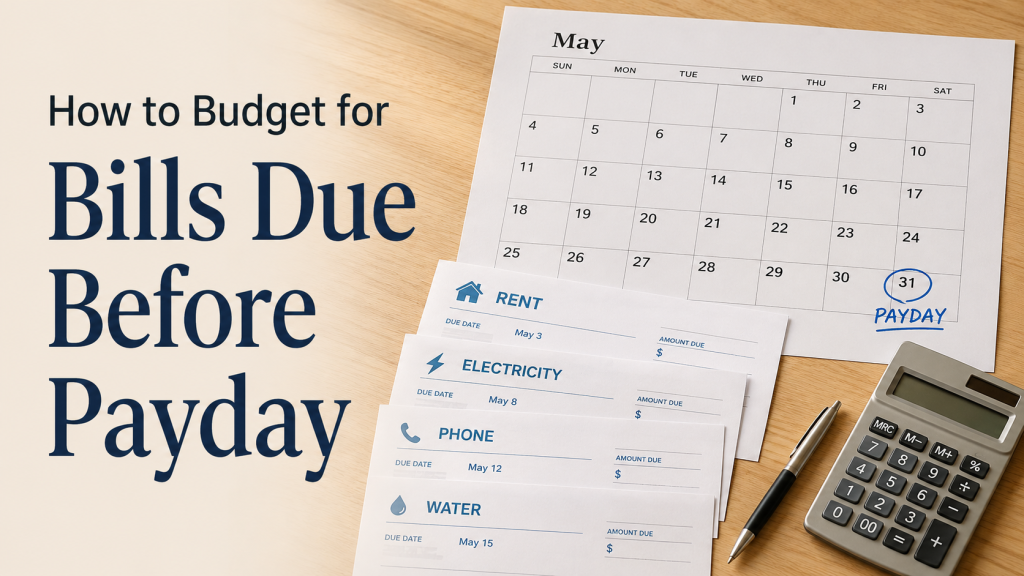
How to Budget for Bills Due Before Payday
Learning how to budget for bills due before payday can prevent a perfectly workable monthly budget from becoming a cash-flow problem.
Sometimes you earn enough money over the full month, but several bills are due before your next paycheck arrives.
For example, your next payday may be on the 18th, while rent, electricity, insurance, and your phone bill are all due between the 1st and 12th.
The issue is not always that you do not earn enough.
The problem may simply be timing.
The solution is to stop waiting for the paycheck immediately before the due date and begin reserving money earlier.
Use the Paycheck Budget Planner Printable to decide which bills each paycheck must cover before the money arrives.
Why Bills Due Before Payday Cause Problems
Suppose you are paid twice per month.
Your paychecks are:
- Paycheck 1: $1,700
- Paycheck 2: $1,700
Total monthly income:
$3,400
Now imagine the following bills are due before Paycheck 2:
- Rent: $1,000
- Electricity: $160
- Phone: $90
- Insurance: $150
- Credit card minimum: $100
Total:
$1,500
Now add:
- Groceries: $250
- Fuel: $120
Total needed before the next payday:
$1,870
But the paycheck was only:
$1,700
Shortage:
$170
Your monthly income may still cover the month overall.
The problem is that too much money is required too early.
How to Budget for Bills Due Before Payday
Step 1: Write Down Every Payday
Start with your actual income dates.
For example:
- September 4
- September 18
- October 2
The first paycheck must cover everything that needs to happen before September 18.
The second paycheck must cover everything needed before October 2.
This creates clear spending windows.
Step 2: List Every Bill Due Before the Next Payday
Write down:
- Bill name
- Due date
- Expected amount
Example:
- Rent — September 5 — $1,000
- Electricity — September 8 — $150
- Phone — September 10 — $85
- Insurance — September 14 — $140
Total:
$1,375
Use the Bill Tracker Printable PDF to organize due dates and actual amounts.
Step 3: Add Groceries and Transportation
Bills are not the only expenses that matter.
You still need money for:
- Food
- Fuel
- Work transportation
- Household basics
- Medication
- School expenses
Suppose the two-week period also requires:
- Groceries: $240
- Fuel: $110
- Household: $40
Total:
$390
Now the real amount needed is:
$1,375 + $390 = $1,765
If the paycheck is $1,700, you are:
$65 short
Now the problem is visible before the money is spent.
Step 4: Use the Previous Paycheck to Reserve Money
This is the most important step.
A bill does not have to be fully funded by the paycheck immediately before it is due.
Suppose next month’s rent is:
$1,000
Reserve part of it from the previous paycheck.
For example:
From Paycheck 2 this month:
$300 for next month’s rent
Then next month’s first paycheck only needs:
$700
This reduces pressure immediately.
Step 5: Split Large Bills Between Paychecks
Large fixed bills are often easier to manage when divided.
Suppose your insurance is:
$200
Instead of taking the full $200 from one paycheck:
Paycheck 1
Reserve:
$100
Paycheck 2
Reserve:
$100
By the time the bill is due, the money is already available.
This method works well for:
- Rent
- Mortgage
- Insurance
- Car payments
- Childcare
- Large utility bills
Step 6: Create a Bill Reserve Category
Do not leave future bill money mixed with general spending.
Create a category such as:
Bills Due Before Payday
or separate categories:
- Rent reserve
- Electricity reserve
- Insurance reserve
- Phone reserve
Suppose your account balance is:
$1,600
but includes:
- Rent reserve: $300
- Insurance reserve: $100
- Electricity reserve: $80
Reserved total:
$480
Available for everything else:
$1,120
The full bank balance is not available spending money.
Step 7: Match Each Bill to the Correct Paycheck
Create a simple table.
Paycheck 1
Covers:
- Rent
- Electricity
- Phone
- Groceries
- Fuel
Paycheck 2
Covers:
- Insurance
- Internet
- Debt
- Groceries
- Fuel
- Future rent reserve
The goal is to make sure one paycheck does not become overloaded every month.
Read How to Plan Bills Around Your Paychecks for a complete cash-flow balancing method.
Step 8: Plan Bills Before Optional Spending
A paycheck should first cover:
- Housing
- Essential utilities
- Groceries
- Transportation
- Insurance
- Healthcare
- Minimum required debt payments
- Other essential bills
- Savings
- Optional spending
If bills are due before payday, optional categories may need to be temporarily lower.
Step 9: Use a Paycheck Buffer
Suppose your paycheck is:
$1,700
Your planned expenses total:
$1,650
Buffer:
$50
That extra $50 can cover:
- Slightly higher groceries
- Extra fuel
- A small utility increase
- A small unexpected household expense
Read How to Build a Budget Buffer for a more complete monthly cushion strategy.
Step 10: Change Due Dates When Possible
If almost every bill is due during the same part of the month, ask whether the due date can be changed.
Possible bills include:
- Credit cards
- Phone
- Internet
- Insurance
- Some utilities
- Loan payments
For example, moving one $150 bill from the 8th to the 22nd may balance the two paycheck periods.
Not every provider allows this, but it can be worth checking.
Step 11: Do Not Wait Until the Bill Is Due
Suppose your electricity bill is due on:
September 9
and payday is:
September 15
Waiting until September 9 to solve the problem is too late.
Instead, the previous paycheck should already include a reserve.
Example:
Previous paycheck:
$75 toward electricity
Next available income:
$75
Total available:
$150
The bill is funded without using credit.
Step 12: Use Realistic Bill Estimates
Do not reserve the lowest possible amount.
Suppose recent electricity bills were:
- $135
- $148
- $160
- $152
Budgeting:
$135
may leave you short.
A better estimate could be:
$155–$160
depending on the season.
Read How to Budget for Bills That Change Every Month for a method using averages and buffers.
Example: Two Paychecks and Early Bills
Suppose you receive:
$1,800 twice per month
Paycheck 1
Bills before next payday:
- Rent: $1,000
- Electricity: $150
- Phone: $80
Flexible essentials:
- Groceries: $250
- Fuel: $120
Total:
$1,600
Remaining:
$200
Now reserve:
$100
for next month’s insurance.
Available buffer:
$100
Paycheck 2
Bills:
- Insurance: $150
- Internet: $70
- Car payment: $300
- Debt: $150
Flexible essentials:
- Groceries: $250
- Fuel: $120
Total:
$1,040
Remaining:
$760
Instead of treating the $760 as free money, reserve part of it for next month’s early bills.
For example:
- Next month rent: $300
- Next month electricity: $75
- Next month phone: $40
- Savings: $100
Total reserved:
$515
This makes the next first paycheck much easier.
Bills Due Before Payday When Paid Weekly
Weekly pay can make the process easier because income arrives more frequently.
Suppose rent is:
$1,200
Reserve:
$300 per week
for four weeks.
By the due date:
$1,200
is ready.
This prevents one weekly paycheck from needing to cover the entire bill.
Read How to Budget When Paid Weekly for a full weekly paycheck system.
Bills Due Before Payday When Paid Biweekly
Suppose you receive:
$1,600 every two weeks
A $1,000 rent payment may be difficult to take from one paycheck while also paying groceries, transportation, and utilities.
You could reserve:
- Previous paycheck: $400
- Current paycheck: $600
Total:
$1,000
Use the Biweekly Budget Planner Printable to divide each paycheck between Week 1, Week 2, bills, and future reserves.
Use Weekly Spending Limits Between Paydays
Suppose your paycheck period lasts two weeks.
Available after bills:
$600
Do not treat the full $600 as flexible money.
You might divide it into:
- Week 1: $300
- Week 2: $300
Or:
- Week 1: $320
- Week 2: $280
Read How to Set a Weekly Spending Limit to protect later-week money.
What if You Are Already Behind?
If a bill is already overdue, your priority is different.
First identify:
- Essential bills
- Amount overdue
- Minimum payment required
- Due date
- Consequences of nonpayment
Then create a catch-up plan.
Read How to Catch Up on Bills When You Are Behind before building future reserves aggressively.
What if Income Is Too Low?
Sometimes the problem is not just timing.
Suppose monthly income is:
$2,500
and essential expenses are:
$2,750
No scheduling method can fully solve that gap.
You may need to:
- Reduce expenses
- Negotiate bills
- Adjust debt payments
- Increase income
- Prioritize essentials
Use the Low Income Budget Planner to build a priority-based plan.
Build One Bill Ahead First
You do not need to get every bill ahead at once.
Choose one.
For example:
Phone bill: $80
Save:
$20 per paycheck
After four paychecks:
$80
Now the phone bill is fully funded before it is due.
Then move to another bill.
This is a simple way to reduce paycheck pressure gradually.
Build Toward One Month Ahead
Once you regularly reserve part of future bills, you are already beginning the process of getting ahead.
You may eventually reach a point where:
- Next month rent is ready
- Next month utilities are ready
- Next month groceries are partly funded
- Next month transportation is funded
Read How to Get One Month Ahead on Bills for the next step.
Common Mistakes With Bills Due Before Payday
Waiting for the Closest Paycheck
Start funding large bills earlier.
Looking Only at the Monthly Budget
Cash-flow timing matters.
Forgetting Groceries and Fuel
The paycheck must cover everyday essentials too.
Spending Reserved Bill Money
Future bill money already has a job.
Funding Large Bills From One Deposit
Split them when necessary.
Using Credit Automatically
First check whether earlier paycheck reserves can solve the problem.
Ignoring Due Dates
A workable monthly budget can still fail if expenses are badly timed.
Having No Buffer
A small margin can prevent normal differences from creating shortages.
Download the Free Paycheck Budget Planner
The printable Paycheck Budget Planner helps you:
- Record each payday
- List bills due before the next paycheck
- Reserve money early
- Split large bills
- Plan groceries and transportation
- Protect future bill money
- Add a paycheck buffer
- Calculate money remaining
Start with your next paycheck and list every bill that must be funded before the following payday.
Explore more free budget templates and printable PDF trackers for weekly budgets, bills, expenses, emergency funds, sinking funds, and low-income planning.
Frequently Asked Questions
What should I do if a bill is due before my next paycheck?
Use money from an earlier paycheck, split the bill between paychecks, or create a reserve before the due date arrives.
Can I split rent between two paychecks?
Yes. Reserving part of rent from each paycheck can make a large housing payment easier to manage.
Should I change my bill due dates?
If one part of the month is overloaded, moving eligible bills to another date may improve cash flow.
What if I still cannot cover the bill?
Review essential expenses, reduce optional spending, check for payment arrangements, and determine whether the issue is timing or an actual income shortfall.
Is a bill reserve the same as savings?
Not exactly. A bill reserve is money already assigned to a future known expense.