
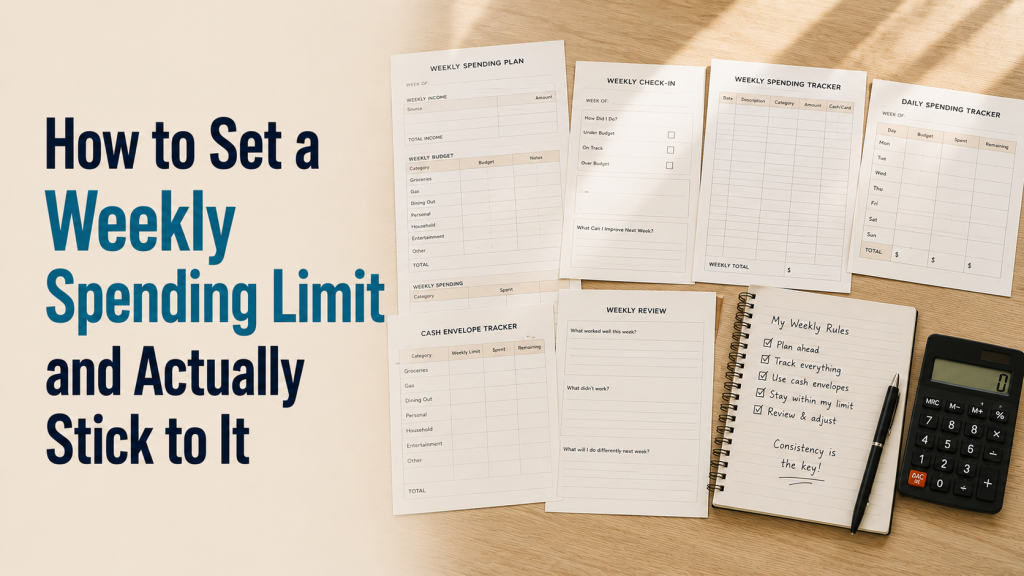
How to Set a Weekly Spending Limit and Actually Stick to It
Learning how to set a weekly spending limit can make a monthly budget much easier to control.
A monthly spending amount may look reasonable on paper, but it gives you a long period of time to overspend before you notice a problem. If too much money disappears during the first week or two, the rest of the month becomes harder.
A weekly spending limit divides flexible expenses into smaller amounts that are easier to monitor.
Instead of asking whether you have enough money for the rest of the month, you only need to answer a simpler question:
How much can I safely spend this week?
Use the Weekly Budget Planner Printable to plan seven days of groceries, transportation, household expenses, personal spending, bills, and money remaining.
What Is a Weekly Spending Limit?
A weekly spending limit is the maximum amount you plan to use for selected flexible expenses during one week.
It may include:
- Groceries
- Fuel
- Takeout
- Household supplies
- Personal spending
- Entertainment
- Clothing
- Small purchases
- Children’s expenses
- Pet expenses
It usually does not include large fixed bills such as rent or mortgage payments.
Those bills should already be reserved separately.
For example, you may have:
- Monthly take-home income: $3,200
- Fixed bills and savings: $2,150
- Flexible spending available: $1,050
Instead of treating the entire $1,050 as available throughout the month, divide it into weekly amounts.
A Simple Weekly Spending Example
Suppose your monthly flexible budget is:
$1,000
You could divide it evenly:
$1,000 ÷ 4 = $250 per week
Your weekly limit becomes:
$250
But your spending may not be identical every week.
A more realistic plan could be:
- Week 1: $280
- Week 2: $230
- Week 3: $230
- Week 4: $260
Total:
$280 + $230 + $230 + $260 = $1,000
The weekly limits are different, but they still protect the monthly total.
Why Weekly Limits Can Work Better Than One Monthly Number
Suppose your monthly grocery budget is:
$600
Without weekly limits, you may spend:
- Week 1: $210
- Week 2: $180
- Week 3: $150
Total after three weeks:
$540
Money left for Week 4:
$600 − $540 = $60
The monthly budget was technically $600, but most of it disappeared too early.
Now suppose you set:
- Week 1: $155
- Week 2: $145
- Week 3: $145
- Week 4: $155
You know immediately when one week is using too much of the monthly budget.
How to Set a Weekly Spending Limit
Step 1: Start With Your Take-Home Income
Use the amount that actually reaches your bank account.
For example:
Monthly take-home income: $3,400Do not build the spending limit from gross salary.
If income changes each month, use a conservative amount for your core budget.
Step 2: Subtract Fixed Bills
List expenses that are not part of everyday flexible spending.
Examples include:
- Rent or mortgage
- Insurance
- Phone
- Internet
- Loan payments
- Minimum debt payments
- Childcare
- Regular subscriptions
- Savings contributions
Example:
- Monthly income: $3,400
- Fixed bills: $1,950
Money remaining:
$3,400 − $1,950 = $1,450
This $1,450 still needs to cover flexible household expenses.
Use the Bill Tracker Printable PDF to make sure all recurring payments are accounted for before calculating weekly spending.
Step 3: Subtract Monthly Savings and Sinking Funds
Savings should not be treated as money available for weekly shopping.
Suppose you plan:
- Emergency savings: $100
- Car maintenance sinking fund: $60
- Annual insurance fund: $40
Total savings and sinking funds:
$200
Remaining flexible money:
$1,450 − $200 = $1,250
Use the Sinking Fund Tracker Printable for predictable future expenses that should not compete with weekly spending.
Step 4: Identify Your Flexible Categories
Now list the categories that change during the month.
For example:
- Groceries: $520
- Transportation: $240
- Household: $100
- Personal spending: $100
- Takeout: $80
- Entertainment: $60
- Miscellaneous: $50
Total:
$1,150
That leaves:
$1,250 − $1,150 = $100
as a monthly buffer.
Step 5: Divide Each Category by Week
Do not only divide the grand total.
It is useful to create weekly limits for your largest flexible categories.
Example:
Groceries
Monthly:
$520
Weekly target:
$130
Transportation
Monthly:
$240
Weekly target:
$60
Household
Monthly:
$100
Weekly target:
$25
Personal spending
Monthly:
$100
Weekly target:
$25
Takeout
Monthly:
$80
Weekly target:
$20
Entertainment
Monthly:
$60
Weekly target:
$15
Total weekly spending target:
$275
Step 6: Adjust for Uneven Weeks
Not every week has the same needs.
One week may include:
- A large grocery stock-up
- More commuting
- A school event
- Household supplies
- A birthday
- A planned family activity
You may decide:
Week 1
$310
Week 2
$260
Week 3
$265
Week 4
$315
Total:
$1,150
The important rule is:
A higher limit in one week requires a lower limit somewhere else.
Step 7: Protect the Following Week’s Money
Do not treat the entire monthly flexible balance as available now.
If Week 2 money is sitting in your checking account during Week 1, it can easily be spent early.
Possible methods include:
- Separate bank spaces
- Weekly cash envelopes
- Digital budget categories
- A written weekly planner
- Weekly transfers into your spending account
For example:
Monthly flexible money:
$1,150
Instead of keeping all $1,150 available, transfer:
Week 1 spending: $310When Week 2 begins, release the next amount.
Step 8: Track Every Purchase During the Week
A spending limit only works if you know how much has already been used.
Suppose your weekly limit is:
$275
By Thursday you have spent:
- Groceries: $118
- Fuel: $55
- Takeout: $22
- Household: $18
- Personal: $27
Total:
$240
Money remaining:
$275 − $240 = $35
You now know that only $35 remains until the next weekly period begins.
Use the Expense Tracker Printable PDF to record purchases and calculate category totals.
Step 9: Check Your Limit Before Shopping
Before making an optional purchase, ask:
- How much remains this week?
- Is this purchase necessary?
- Which category will pay for it?
- Will another expense still occur before the week ends?
Suppose you have:
$42 remainingand want to spend:
$35 on takeoutBut you still need fuel before the week ends.
The bank balance may allow the purchase.
The weekly plan may not.
Step 10: Do a Midweek Check
Choose one day, such as Wednesday or Thursday.
Check:
- Weekly limit
- Amount already spent
- Grocery money remaining
- Fuel needed
- Bills still due
- Optional spending remaining
For example:
- Weekly limit: $275
- Spent by Wednesday: $155
- Remaining: $120
If three days remain and a grocery trip is still needed, you can adjust before the money disappears.
Step 11: Decide What Happens to Money You Do Not Spend
Suppose your weekly limit was:
$275
Actual spending:
$238
Money left:
$37
You can:
- Carry it into the next week
- Add it to the monthly buffer
- Move it to emergency savings
- Add it to a sinking fund
- Make an extra debt payment
Do not feel obligated to spend the full limit.
A limit is a maximum, not a goal.
Step 12: Decide What Happens When You Go Over
Suppose:
- Weekly limit: $275
- Actual spending: $310
Overspending:
$35
First identify why.
Was it:
- Higher groceries?
- Necessary fuel?
- Takeout?
- Shopping?
- An unexpected expense?
Then decide how to cover it.
Possible options:
- Reduce next week by $35
- Use part of the monthly buffer
- Reduce another flexible category
- Accept a necessary temporary increase and adjust the monthly plan
Do not ignore it.
If the extra $35 disappears without an adjustment, the monthly budget will eventually become short.
Weekly Limits for Groceries
Groceries are one of the easiest categories to manage weekly.
Suppose your monthly food budget is:
$560
You could plan:
- Week 1: $150
- Week 2: $135
- Week 3: $135
- Week 4: $140
Total:
$560
After every grocery trip, subtract the amount from that week’s limit.
For a more detailed method, read How to Stop Overspending on Groceries.
Weekly Limits for Personal Spending
Personal spending often becomes difficult to control because many purchases are small.
Suppose your monthly personal budget is:
$120
Weekly limit:
$30
That $30 may include:
- Snacks
- Coffee
- Small shopping
- Entertainment
- Personal items
If you spend the $30 by Tuesday, the category is finished until the next weekly period.
Weekly Limits When Paid Weekly
Weekly pay makes this system especially simple.
Suppose your take-home paycheck is:
$800
You assign:
- Rent reserve: $300
- Utilities reserve: $70
- Groceries: $125
- Transportation: $60
- Savings: $25
- Debt: $70
- Personal spending: $40
- Buffer: $30
Total assigned:
$720
Money remaining:
$80
Some of that $80 may need to support a future larger bill.
Read How to Budget When Paid Weekly for the full paycheck method.
Weekly Limits When Paid Biweekly
If you receive one paycheck every two weeks, divide flexible spending immediately.
Suppose:
- Two-week grocery amount: $270
- Transportation: $130
- Personal spending: $70
- Household: $50
Total:
$520
Split it:
Week 1
$265
Week 2
$255
Do not use Week 2 money during Week 1.
Read How to Split a Biweekly Paycheck for a detailed example.
How Weekly Limits Help When Money Is Tight
When income is limited, a smaller planning window can make shortages visible earlier.
For example:
Monthly flexible budget:
$800
Weekly target:
$200
After Week 1 you spend:
$247
You are already:
$47 over
Without a weekly review, you may not notice until much later.
When essential expenses already use most of your income, use the Low Income Budget Planner to establish priorities before creating weekly discretionary limits.
How Weekly Limits Help Stop Payday Overspending
Some people spend more immediately after income arrives.
A weekly limit prevents the entire flexible balance from feeling available.
Instead of seeing:
$1,100 available for the monthyou focus on:
$275 available this weekThe smaller number creates a clearer boundary.
For additional paycheck planning, read How to Make Your Paycheck Last Until Next Payday.
Use a Weekly Buffer
A weekly budget does not need to be exact down to the final dollar.
Include a small buffer.
For example:
- Planned flexible expenses: $260
- Weekly buffer: $15
- Maximum weekly spending: $275
The $15 can cover:
- Grocery price differences
- Additional fuel
- Small household needs
- Unexpected school expenses
Do not automatically spend the buffer.
What if One Week Is Much More Expensive?
Some weeks will naturally cost more.
For example:
- Week 1: $350
- Week 2: $240
- Week 3: $250
- Week 4: $310
Total:
$1,150
The solution is not to force every week into an identical number.
The goal is to plan the difference before spending happens.
Common Weekly Spending Limit Mistakes
Making the Limit Too Low
Use recent spending as your starting point.
A limit that cannot cover normal groceries and transportation will fail.
Forgetting Bills
Reserve fixed bills before calculating flexible spending.
Counting Savings as Available Money
Separate savings from weekly spending.
Using Next Week’s Money Early
Protect future weekly amounts.
Ignoring Small Purchases
Small spending still counts toward the limit.
Giving Up After One Expensive Week
Adjust the following week instead of abandoning the entire budget.
Spending Everything Because It Is Available
A weekly limit is a ceiling, not a spending target.
Never Reviewing Actual Results
Compare the planned limit with actual spending every week.
Download the Free Weekly Budget Planner
The printable planner helps you:
- Set a weekly spending limit
- Plan groceries and transportation
- Record bills and essentials
- Track daily purchases
- Calculate money remaining
- Compare planned and actual spending
- Review overspending
- Prepare the next week
Start by choosing one realistic weekly amount and track every flexible purchase for seven days.
Explore more free budget templates and printable PDF trackers for paycheck budgeting, expenses, bills, debt, emergency savings, and low-income planning.
Frequently Asked Questions
How do I calculate a weekly spending limit?
Subtract fixed bills, savings, and other required expenses from your income, then divide the flexible spending amount between the weeks in the month.
Should every week have the same spending limit?
No. Some weeks naturally cost more. Adjust individual weekly limits while keeping the total monthly amount unchanged.
What should count toward my weekly spending limit?
Usually groceries, transportation, household spending, personal purchases, takeout, entertainment, and other flexible expenses.
What happens if I go over my weekly limit?
Identify the reason, then reduce another flexible category, use part of a planned buffer, or adjust the following week.
Should I spend money left at the end of the week?
No. You can carry it forward or add it to savings, debt payoff, a sinking fund, or your monthly buffer.