
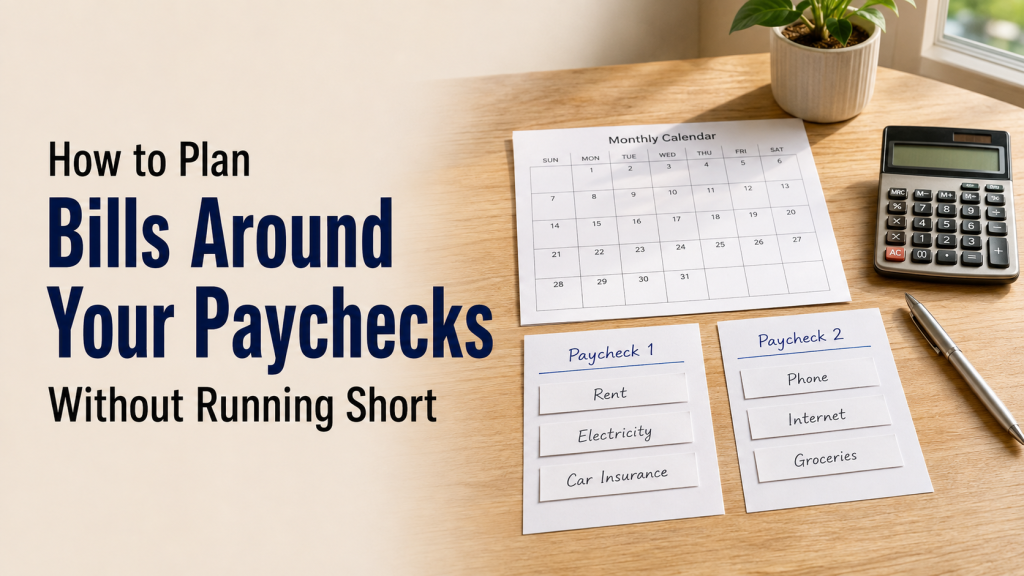
How to Plan Bills Around Your Paychecks Without Running Short
Learning how to plan bills around your paychecks can make your monthly budget much easier to manage.
A monthly budget may show that you earn enough money to cover your expenses, but timing can still create problems.
You might receive two paychecks during the month while most of your bills are due shortly after the first one.
That can leave the first paycheck overloaded and the second paycheck looking unusually large.
The solution is to stop thinking only in monthly totals and begin assigning each bill to a specific paycheck.
Use the Paycheck Budget Planner Printable to decide which expenses each paycheck needs to cover before the money arrives.
Why Bill Timing Matters
Suppose your monthly take-home income is:
$3,400
You receive:
- Paycheck 1: $1,700
- Paycheck 2: $1,700
Your total monthly expenses are:
$3,200
On paper, the budget works.
But imagine these bills are due before the second paycheck:
- Rent: $1,000
- Electricity: $160
- Phone: $90
- Insurance: $150
- Groceries: $250
- Fuel: $120
Total:
$1,770
Your first paycheck is only:
$1,700
You are already:
$70 short
before accounting for anything else.
Meanwhile, several expenses may not be due until later in the month.
This is not necessarily an income problem.
It is a cash-flow timing problem.
What Does It Mean to Budget Bills by Paycheck?
Budgeting bills by paycheck means deciding in advance which income deposit will fund each expense.
For example:
Paycheck 1
- Rent
- Electricity
- Groceries
- Fuel
- Phone
Paycheck 2
- Insurance
- Internet
- Debt payment
- Groceries
- Fuel
- Savings
Instead of asking:
Can my monthly income cover everything?
you ask:
What does this paycheck need to cover before the next paycheck arrives?
That smaller question is often much easier to manage.
How to Plan Bills Around Your Paychecks
Step 1: Write Down Every Payday
Start with your actual paycheck dates.
Example:
- Paycheck 1 — September 4
- Paycheck 2 — September 18
Then determine the next payday:
- Paycheck 3 — October 2
The first September paycheck must therefore cover expenses from:
September 4 through September 17
The second paycheck must cover:
September 18 through October 1
That gives each paycheck a clear responsibility.
Step 2: List Every Bill and Due Date
Create a complete list.
For example:
- Rent — September 5 — $1,000
- Electricity — September 8 — $150
- Phone — September 11 — $85
- Insurance — September 16 — $140
- Internet — September 20 — $70
- Credit card minimum — September 24 — $100
- Car payment — September 27 — $280
Use the Bill Tracker Printable PDF to organize bills by due date and payment status.
Step 3: Assign Bills to the Paycheck Before Their Due Date
A simple first rule is:
Fund each bill from the paycheck that arrives before the due date.
Using the previous example:
Paycheck 1 — September 4
Needs to cover:
- Rent: $1,000
- Electricity: $150
- Phone: $85
- Insurance: $140
Bills total:
$1,375
Paycheck 2 — September 18
Needs to cover:
- Internet: $70
- Credit card: $100
- Car payment: $280
Bills total:
$450
Immediately you can see that Paycheck 1 is much more heavily loaded.
Step 4: Add Expenses That Do Not Have Due Dates
Bills are only part of the paycheck budget.
Each paycheck also needs to cover everyday essentials.
Examples:
- Groceries
- Fuel
- Public transportation
- Household supplies
- Medication
- Personal spending
- Child-related expenses
Suppose each two-week period needs:
- Groceries: $250
- Fuel: $120
- Household: $40
- Personal spending: $50
Total:
$460
Now Paycheck 1 needs:
Bills:
$1,375
Flexible essentials:
$460
Total:
$1,835
But the paycheck is:
$1,700
Shortage:
$135
Now the timing problem is clearly visible.
Step 5: Move Some Future Bills to an Earlier Paycheck
A bill does not need to be funded only from the paycheck immediately before it is due.
Suppose Paycheck 2 has much more room.
The next month’s rent is:
$1,000
Instead of expecting the following first paycheck to cover all $1,000, start reserving part of it earlier.
For example:
From Paycheck 2:
$250 toward next month’s rent
Then the next first paycheck needs to provide only:
$750
This begins balancing the two paycheck periods.
Step 6: Split Large Bills Between Paychecks
Large expenses can be divided.
Suppose rent is:
$1,000
Instead of taking the entire amount from one paycheck:
Paycheck 1
Reserve:
$500
Paycheck 2
Reserve:
$500
By the time rent is due, the full:
$1,000
is available.
This technique works well for:
- Rent or mortgage
- Insurance
- Large utility bills
- Car payments
- Childcare
- Debt payments
Step 7: Create Bill Reserves
Suppose car insurance costs:
$180
and is due after the first paycheck of the month.
Reserve:
$90
from the previous paycheck.
Then reserve another:
$90
from the next one.
This prevents one paycheck from carrying the full cost.
The money should remain untouched until the bill is due.
Step 8: Balance the Two Paychecks
Your paychecks do not need to contain identical expenses.
But one should not repeatedly become impossible while the other has significant leftover money.
Example before balancing:
Paycheck 1
Income:
$1,700
Expenses:
$1,835
Short:
$135
Paycheck 2
Income:
$1,700
Expenses:
$1,365
Remaining:
$335
You could move:
$200
of future bills into Paycheck 2.
New result:
Paycheck 1
Expenses:
$1,635
Remaining:
$65
Paycheck 2
Expenses:
$1,565
Remaining:
$135
This is much more stable.
Step 9: Plan Groceries Between Paydays
Do not put one full monthly grocery amount under one paycheck.
Suppose groceries cost:
$520 per month
With two paychecks, you might start with:
- Paycheck 1 groceries: $260
- Paycheck 2 groceries: $260
Or adjust based on the actual number of days.
For example:
- First period: $240
- Second period: $280
Use the Weekly Budget Planner Printable if dividing groceries into weekly limits makes the category easier to control.
Step 10: Plan Transportation the Same Way
Suppose monthly transportation is:
$240
Reserve:
- Paycheck 1: $120
- Paycheck 2: $120
If one pay period contains more commuting days, adjust accordingly.
The goal is to make sure transportation money lasts until the next payday.
Step 11: Reserve Savings Before Optional Spending
Once essential bills and everyday needs are covered, add savings.
For example:
Paycheck:
$1,700
Required bills:
$750
Groceries and transportation:
$380
Other essentials:
$150
Remaining:
$420
You might assign:
- Emergency savings: $50
- Sinking funds: $50
- Next-month reserve: $100
- Personal spending: $70
- Buffer: $50
Remaining:
$100
Every dollar now has a purpose.
Step 12: Add a Small Paycheck Buffer
Paycheck budgets also benefit from some breathing room.
Suppose your paycheck plan totals:
$1,650
and your paycheck is:
$1,700
Buffer:
$50
That $50 can handle:
- Higher groceries
- Additional fuel
- Small household expense
- Slightly higher bill
Read How to Build a Budget Buffer for a complete monthly buffer strategy.
Example: Planning Two Paychecks
Suppose monthly income is:
$3,600
Two paychecks:
$1,800 each
Paycheck 1
- Rent reserve: $600
- Electricity: $150
- Phone: $80
- Groceries: $250
- Transportation: $120
- Household: $50
- Savings: $75
- Personal spending: $50
- Next-month rent reserve: $200
Total:
$1,575
Remaining:
$225
Paycheck 2
- Remaining rent reserve: $400
- Insurance: $150
- Internet: $70
- Car payment: $280
- Groceries: $270
- Transportation: $120
- Debt: $150
- Savings: $75
- Buffer: $50
Total:
$1,565
Remaining:
$235
The two paycheck periods are now reasonably balanced.
What if Most Bills Are Due at the Beginning of the Month?
This is very common.
Suppose these are all due between the 1st and 10th:
- Rent
- Electricity
- Insurance
- Phone
- Loan payment
Do not wait for the new month to begin funding them.
Use the final paycheck of the previous month to reserve part of those costs.
For example:
Bills due early next month:
$1,500
Reserve from the previous paycheck:
$500
Now the first paycheck of the new month only needs:
$1,000
This creates a smoother transition.
Getting One Paycheck Ahead
Once bill timing is stable, your next goal can be having money reserved before the paycheck period begins.
For example:
Instead of receiving Friday’s paycheck and immediately needing it for Saturday’s bills, you already have some money available.
Start small:
- $50 ahead
- $100 ahead
- One bill ahead
- One week of groceries ahead
- Half a paycheck ahead
Eventually, you may work toward funding an entire month in advance.
Read How to Get One Month Ahead on Bills for the gradual method.
How to Plan Bills When Paid Biweekly
Biweekly pay creates 26 paychecks per year.
Most months contain two paychecks, but two months usually contain three.
Your basic method remains:
- Identify the payday.
- Identify the following payday.
- Fund everything needed between those dates.
- Reserve part of future large bills when possible.
Use the Biweekly Budget Planner Printable to separate Week 1 and Week 2 spending within each paycheck period.
How to Plan Bills When Paid Weekly
Weekly pay gives you smaller but more frequent income deposits.
Suppose your monthly rent is:
$1,200
You might reserve:
$300 from four weekly paychecks
Rather than trying to find the entire $1,200 at once.
The same method can work for:
- Utilities
- Insurance
- Debt payments
- Large subscriptions
Read How to Budget When Paid Weekly for a detailed weekly paycheck plan.
What if Your Bills Are More Than One Paycheck?
This does not automatically mean you cannot afford them.
Check the monthly totals first.
If total monthly income covers total monthly expenses, the issue may be timing.
Possible solutions include:
- Reserving part of the bill from an earlier paycheck
- Splitting the bill between paychecks
- Moving a due date if the company allows it
- Reducing optional spending
- Building a paycheck buffer
- Getting one paycheck ahead
Do not rely on overdrafts or credit cards simply because the due dates are inconvenient.
Should You Change Bill Due Dates?
Sometimes changing a due date can help.
For example, if nearly every major bill is due during the first half of the month, moving one or two bills later may create better balance.
Possible candidates include:
- Credit cards
- Phone bills
- Internet
- Insurance
- Some utilities
- Loan payments
Not every provider allows changes, and rules vary.
But it can be worth checking.
How to Handle Bills That Change Every Month
Some bills do not have a fixed amount.
For example:
- Electricity
- Water
- Gas
- Fuel
Use a realistic estimate.
Suppose recent electricity bills were:
- $130
- $145
- $160
- $150
Instead of budgeting:
$130
use something closer to:
$150–$160
depending on the season.
Read How to Budget for Bills That Change Every Month to calculate averages and buffers.
What if Money Is Tight?
When income barely covers expenses, assign essentials first.
Suggested order:
- Housing
- Essential utilities
- Food
- Transportation required for work
- Healthcare
- Insurance
- Minimum required debt payments
- Other essential bills
- Savings if possible
- Optional spending
Use the Low Income Budget Planner if there is not enough money for every category.
If you are already behind on bills, read How to Catch Up on Bills When You Are Behind before focusing on future reserves.
Common Paycheck Bill Planning Mistakes
Looking Only at Monthly Totals
Monthly income may be sufficient while one paycheck is overloaded.
Forgetting Expenses Between Paydays
Groceries and fuel need to be included with bills.
Funding Large Bills From One Paycheck
Split large expenses when necessary.
Spending Future Bill Money
Reserved money already has a job.
Ignoring the Next Month
The final paycheck of this month may need to fund early bills next month.
Treating the Second Paycheck as Extra Money
Future expenses may already depend on it.
Having No Buffer
Even $25–$50 can provide useful flexibility.
Not Reviewing Due Dates
Bill timing is part of the budget.
Download the Free Paycheck Budget Planner
The printable Paycheck Budget Planner helps you:
- Record each paycheck
- List bills due before the next payday
- Assign bills to specific paychecks
- Plan groceries and transportation
- Reserve money for future bills
- Track savings and debt
- Add a paycheck buffer
- Calculate money remaining
Start with your next payday and list every expense that must be covered before the following paycheck arrives.
Explore more free budget templates and printable PDF trackers for weekly budgets, bills, expenses, savings, debt, and low-income planning.
Frequently Asked Questions
How do I decide which paycheck pays which bill?
Assign each bill to the paycheck that arrives before its due date, then move or split larger bills if one paycheck becomes overloaded.
Can I split one bill between two paychecks?
Yes. Reserving part of a large bill from multiple paychecks can make cash flow much easier to manage.
What expenses should I include besides bills?
Include groceries, transportation, household expenses, healthcare, personal spending, and any other costs that occur before the next payday.
What if most of my bills are due at the beginning of the month?
Use the final paycheck from the previous month to begin reserving money for those bills.
Is budgeting by paycheck better than monthly budgeting?
The two methods can work together. A monthly budget shows the full financial picture, while paycheck budgeting manages the timing of income and expenses.