
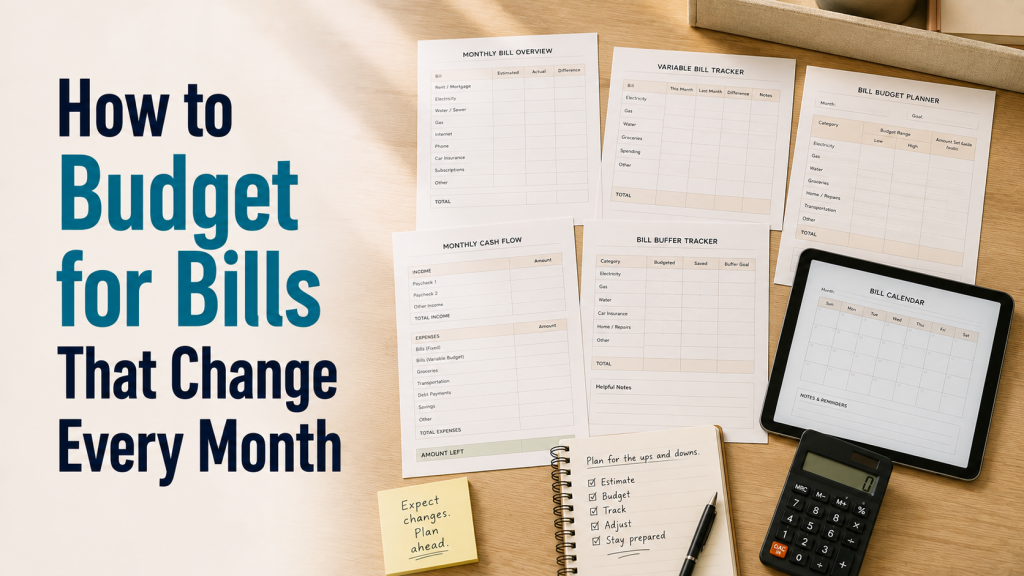
How to Budget for Bills That Change Every Month
Learning how to budget for bills that change every month can prevent higher utility costs, fuel expenses, groceries, and other variable bills from unexpectedly breaking your monthly plan.
Some expenses are easy to budget because the amount stays almost the same.
Others may change significantly from one month to the next.
An electricity bill might be $110 one month and $175 the next. Fuel spending may increase because of additional driving. A phone bill may include an unexpected charge. Heating costs may rise during winter.
The solution is not to guess the lowest possible amount.
Instead, use previous bills, realistic averages, and a small buffer to create a budget that can handle normal changes.
Use the Bill Tracker Printable PDF to record bill amounts, due dates, payment frequency, and the differences between planned and actual costs.
Which Bills Can Change Every Month?
Variable bills and expenses may include:
- Electricity
- Gas
- Heating
- Water
- Phone
- Internet
- Fuel
- Public transportation
- Groceries
- Medical costs
- Pet expenses
- Household supplies
- Childcare
- School expenses
Some bills vary only slightly.
Others may change significantly because of:
- Weather
- Seasonal energy use
- Work schedules
- Travel
- Household size
- Price increases
- Usage
- One-time fees
The goal is to identify which expenses fluctuate and plan accordingly.
A Realistic Variable Bill Example
Imagine that your electricity bills for the last six months were:
- January: $168
- February: $154
- March: $132
- April: $108
- May: $115
- June: $143
Total:
$168 + $154 + $132 + $108 + $115 + $143 = $820
Average:
$820 ÷ 6 = approximately $137
If you budget only:
$110
because that was one of the cheaper months, several future bills may exceed your plan.
A better starting estimate might be:
$140–$150 per month
depending on the season.
That provides more realistic protection.
How to Budget for Bills That Change Every Month
Step 1: Collect the Previous Bills
Start with at least:
3–6 months
of past bills.
For seasonal expenses such as electricity or heating, reviewing:
12 months
is even better.
Look at:
- Online account history
- Bank statements
- Email bills
- Paper statements
- Previous budget records
Write down the actual amount for each month.
Do not rely on memory.
Step 2: Find the Average
Add the bills together and divide by the number of months.
Suppose your water bills were:
- $72
- $81
- $77
- $95
- $84
- $89
Total:
$498
Average:
$498 ÷ 6 = $83
You could begin with a monthly budget of approximately:
$85
But the average should not always be your final number.
You also need to consider seasonal changes.
Step 3: Identify the Highest Normal Amount
Look for the highest bill that occurred during a normal month.
For example:
- Average electricity bill: $137
- Highest normal bill: $168
If your budget has enough room, you might plan:
$150
instead of exactly $137.
This gives you some protection when the bill is higher than average.
Step 4: Look for Seasonal Patterns
Utility bills often follow predictable seasonal patterns.
For example:
Winter
- Heating: higher
- Electricity: higher
- Fuel: possibly higher
Summer
- Air conditioning: higher
- Water: possibly higher
- Travel fuel: possibly higher
Instead of using one identical amount all year, you might create seasonal estimates.
Example:
- Winter electricity budget: $160
- Spring: $125
- Summer: $145
- Fall: $130
A realistic seasonal plan can be more useful than one annual average.
Step 5: Add a Variable Bill Buffer
Suppose your expected electricity bill is:
$140
Add a buffer of:
$15
Budgeted amount:
$155
If the actual bill is:
$146
you still have:
$9
left in the category.
If the bill is:
$154
the budget still works.
A small buffer prevents minor changes from affecting groceries or transportation.
Step 6: Keep Leftover Money in the Category
Suppose you budget:
$150
for electricity.
Actual bill:
$128
Difference:
$22
Instead of spending the $22 automatically, consider leaving it available for a future higher bill.
After three cheaper months, you might have:
- Month 1 leftover: $22
- Month 2 leftover: $15
- Month 3 leftover: $19
Total:
$56
That $56 can help when a future bill jumps.
Step 7: Separate Fixed Bills From Variable Bills
Create two groups.
Fixed bills
Examples:
- Rent
- Insurance
- Loan payments
- Subscription services
Variable bills
Examples:
- Electricity
- Water
- Gas
- Groceries
- Fuel
This makes it easier to see where uncertainty exists.
Use the Simple Budget Planner to compare planned and actual monthly expenses across both groups.
Step 8: Track the Actual Amount Every Month
After the bill arrives, record:
- Planned amount
- Actual amount
- Difference
For example:
| Bill | Planned | Actual | Difference |
|---|---|---|---|
| Electricity | $150 | $164 | +$14 |
| Water | $85 | $78 | -$7 |
| Gas | $90 | $101 | +$11 |
| Phone | $75 | $75 | $0 |
This helps you improve future estimates.
Step 9: Review Your Average Every Few Months
Variable bills change over time.
Prices may increase.
Your household may change.
Energy use may change.
Do not keep using an old average forever.
Review variable bills every:
3–6 months
and update the budget when necessary.
For highly seasonal bills, review the same season from the previous year.
Step 10: Check for Unusual One-Time Charges
Not every high bill should become your new normal budget.
Suppose your phone bill is normally:
$70
but one month it reaches:
$145
because of a one-time charge.
Do not automatically calculate future months around $145.
Identify why the bill changed.
Ask:
- Was it a fee?
- Was there extra usage?
- Was equipment purchased?
- Was a discount removed?
- Was the billing period longer?
- Was there an error?
Separate unusual charges from normal fluctuations.
How to Budget for Electricity
Electricity can change because of:
- Heating
- Air conditioning
- Seasonal daylight
- Appliances
- Household occupancy
- Rate changes
Review the previous year.
Suppose bills were:
- Winter average: $165
- Spring average: $120
- Summer average: $150
- Fall average: $130
Use seasonal amounts instead of one flat $140 estimate.
This can reduce surprises during high-use periods.
How to Budget for Water
Water bills may change based on:
- Household usage
- Garden watering
- Seasonal use
- Billing frequency
- Price increases
If the water bill arrives every two months, convert it into a monthly reserve.
For example:
Average bill every two months:
$160
Monthly reserve:
$160 ÷ 2 = $80
Set aside $80 each month even when no bill is due.
How to Budget for Gas or Heating
Heating costs may vary significantly between seasons.
Suppose winter gas bills are:
- December: $145
- January: $190
- February: $180
Average winter bill:
$515 ÷ 3 = approximately $172
A winter budget of:
$175–$185
may be more realistic than the annual average.
During cheaper months, consider keeping part of the difference for winter.
How to Budget for Fuel
Fuel is not technically a bill, but it is a common variable expense.
Review:
- Commute distance
- Number of workdays
- School transportation
- Regular family trips
- Current fuel spending
Suppose recent monthly fuel costs were:
- $180
- $215
- $195
- $230
Average:
$820 ÷ 4 = $205
A realistic budget might be:
$210–$220
rather than $180.
Use the Expense Tracker Printable PDF to separate routine transportation spending from unusual trips.
How to Budget for Groceries
Groceries also fluctuate.
Suppose recent grocery totals were:
- $510
- $545
- $530
- $575
Average:
$2,160 ÷ 4 = $540
If you repeatedly budget:
$450
the category will appear over budget almost every month.
A realistic $540–$550 budget is more useful.
For more control, divide the amount into weekly limits.
Read How to Set a Weekly Spending Limit for the full method.
What if a Bill Suddenly Becomes Much Higher?
Suppose you expected:
$150
but the bill arrives at:
$230
Difference:
$80
First determine why.
Check:
- Usage
- Billing period
- Rate increase
- One-time fee
- Estimated meter reading
- Previous unpaid balance
- Error
Then decide how to handle the $80 difference.
Possible sources include:
- Variable-bill buffer
- Monthly general buffer
- Money left from another variable category
- Reduced optional spending
- Emergency savings only if appropriate
Do not automatically use a credit card without understanding the cause.
Create a Monthly Bill Buffer
You may prefer one general buffer instead of a separate buffer for every bill.
For example:
Variable bills:
- Electricity: $150
- Water: $85
- Gas: $90
- Fuel: $210
Total:
$535
General variable bill buffer:
$50
Total reserved:
$585
If electricity is $20 higher but fuel is $15 lower, the buffer can absorb the difference.
What if Your Income Is Tight?
When there is very little room in the budget, variable bills need extra attention.
Use conservative estimates.
Suppose electricity typically ranges from:
$120–$170
If your budget only works at $120, the plan is fragile.
Budget closer to:
$150–$160
when possible.
If even the higher estimate cannot fit, review the complete priority budget with the Low Income Budget Planner.
Do not build a tight budget around the cheapest possible month.
Assign Variable Bills to Paychecks
Variable bills still need to be connected to income.
Suppose electricity is due after your second paycheck.
Expected bill:
$160
Instead of finding the full $160 at once, reserve:
- Paycheck 1: $80
- Paycheck 2: $80
Use the Paycheck Budget Planner Printable to reserve part of future bills before their due dates.
What if You Are Paid Weekly?
A monthly variable bill can be divided among weekly paychecks.
Suppose your expected electricity bill is:
$160
Approximate weekly reserve:
$160 ÷ 4 = $40
You could reserve:
$40 from each weekly paycheck
When the bill arrives, the money is already available.
Use a Sinking Fund for Large Seasonal Costs
Some variable expenses are large enough to deserve their own savings category.
Examples:
- Winter heating
- Annual fuel expenses
- Seasonal utility increases
- Home maintenance
- Car repairs
Suppose winter heating costs approximately:
$600 more than summer heating
Saving:
$50 per month
creates:
$600 per year
Use the Sinking Fund Tracker Printable to prepare gradually for predictable seasonal increases.
Variable Bills Versus Irregular Expenses
These are related but not identical.
Variable bill
Occurs regularly, but the amount changes.
Examples:
- Electricity
- Water
- Groceries
- Fuel
Irregular expense
Does not occur every month.
Examples:
- Annual insurance
- Car repair
- School supplies
- Holiday spending
For irregular costs, read How to Save for Irregular Expenses.
What to Do With a Cheaper Month
Suppose you budget:
$160
and the bill is:
$115
Difference:
$45
Possible uses:
- Keep it in the variable-bill buffer
- Save it for the same bill next month
- Add it to emergency savings
- Add it to a sinking fund
- Carry it into the next budget
Do not automatically increase optional spending because one bill happened to be cheap.
Common Variable Bill Budgeting Mistakes
Using the Lowest Recent Bill
Use an average or conservative estimate instead.
Ignoring Seasons
Heating and electricity may change significantly during the year.
Spending Leftover Bill Money
Keeping some of it can protect future months.
Never Updating the Average
Review real bills several times per year.
Treating Every High Bill as Normal
Check for one-time charges and errors.
Having No Buffer
Even a $20–$50 monthly cushion can help.
Forgetting Payment Timing
Assign bill reserves to specific paychecks.
Guessing Instead of Tracking
Use real historical amounts whenever possible.
Download the Free Bill Tracker
The printable Bill Tracker helps you:
- Record monthly bills
- Track due dates
- Compare planned and actual amounts
- Organize bills by paycheck
- Track irregular and annual expenses
- Identify variable costs
- Record payment status
- Review bill changes every month
Start by entering the last several months of your most unpredictable bills and calculate a realistic planning amount.
Explore more free budget templates and printable PDF trackers for weekly planning, expenses, paychecks, debt, savings, and low-income budgeting.
Frequently Asked Questions
How do I budget for a bill when I do not know the exact amount?
Review several previous bills, calculate an average, consider seasonal changes, and add a small buffer.
Should I budget the average or the highest bill?
Use a realistic amount between the average and the higher normal range when your budget allows.
What should I do with money left after a cheaper bill?
Keep it in the category, add it to a variable-bill buffer, or move it toward savings instead of automatically spending it.
How often should I update variable bill amounts?
Review them every three to six months or whenever rates, usage, or household circumstances change.
Should seasonal bills use the same budget all year?
Not necessarily. Seasonal estimates may be more accurate for electricity, heating, water, and other weather-dependent expenses.